October 09, 2026

Posted on: 10/9/2026 | By Tricia Cave

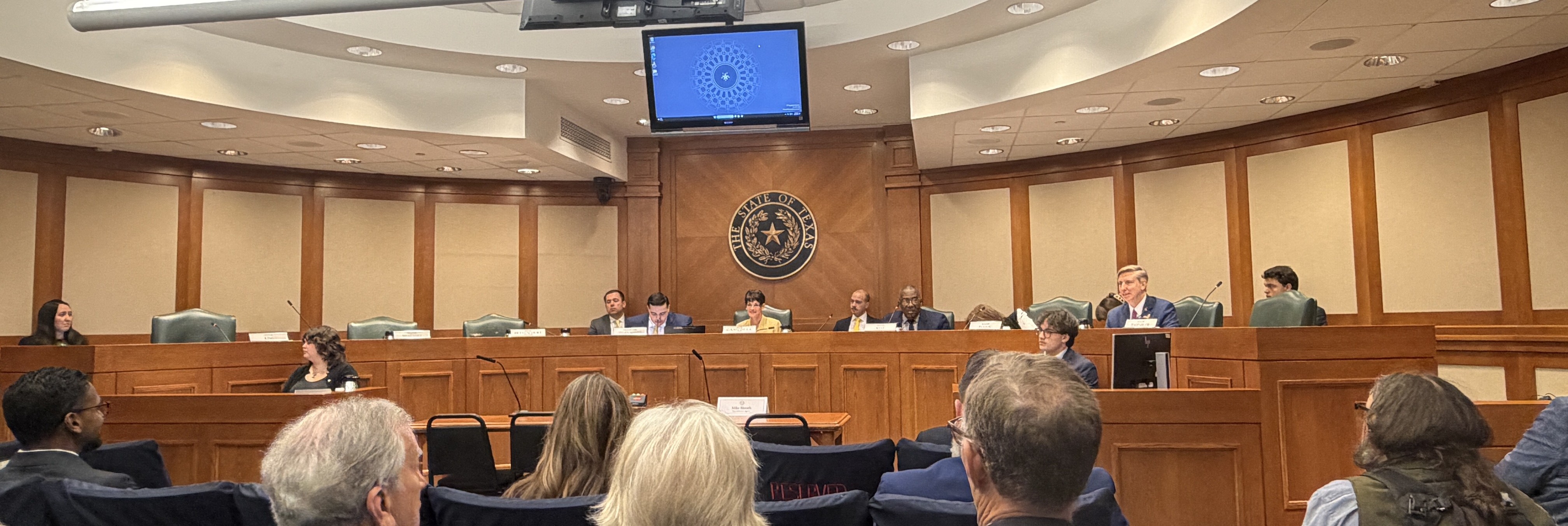
The Senate Education Committee met for a second day of interim hearings on Wednesday, Oct. 7. Interim charges on the agenda included evaluating the implementation of the voucher program, studying implementation of laws concerning parental rights and library books, and student discipline.
Lt. Gov. Dan Patrick (R) directed the committee through his interim charges to “celebrate the successful rollout of school choice.” Wednesday’s hearing showed that any celebration concerning this program is very premature, as serious questions remain regarding who is receiving the funds and how they are being used.
Travis Pillow, the Interim Program Director for the Texas Education Freedom Accounts (TEFA) program at the Comptroller’s office, told the committee that more than 274,000 applications had been received for TEFA, with more than 116,000 participants and 95,000 students waitlisted. The comptroller’s office is asking for $2.3 billion to fund the program next biennium, with an additional $2.1 billion identified as needed to fund waitlisted students and eligible siblings of students already in the program.
Sen. Royce West (D–Dallas) questioned what the application numbers revealed about families’ needs, particularly for pre-kindergarten. West questioned Pillow about the number of applications received for pre- and kindergarten, pointing out that there were more applications for these grades than any other grade level by far. Pillow, through much of the exchange, seemed to avoid answering West’s questions directly, and West took the opportunity to point out that the numbers don’t necessarily show enthusiasm for vouchers so much as they demonstrate that the state, and the country at large, has a problem with unaffordable childcare. ATPE provided written testimony to the committee that also highlighted this need and recommended that the Legislature invest in high-quality full-day pre-K through the existing public school system in order to address the need for Texas families.
Sen. Jose Menendez (D–San Antonio) also questioned how the program handles students with disabilities. Pillow confirmed that about one in four students with disabilities who received a TEFA award opted out and said the state plans to survey the families to examine the reasons why. Menendez also raised concerns about public school districts bearing the costs of special education evaluations for students who do not attend public school but request the evaluations to qualify for additional funding under the TEFA program. ATPE has consistently advocated for the state to move these evaluations to third-party evaluators rather than continuing to burden public schools with the additional costs and labor required to perform these evaluations for students who do not even attend their schools.
It is also important to note that the number of applications and awards does not establish how many students are moving from public schools or whether the program is improving educational outcomes. Data cited during the hearing showed that 70% of the awardees in grades 1-12 had already been enrolled in private school or homeschool prior to receiving a voucher. This means that the program is demonstrably not helping the families it was ostensibly written to help but rather is subsidizing the cost of tuition for families who had already chosen non-public options. In our written testimony, ATPE encouraged the state to study the reasons why the funds are not going to the people they were supposed to be intended to help and asked the Legislature to wait and study more data before attempting to expand the program.
State Board of Education Chair Aaron Kinsey (R–Lubbock) delivered invited testimony to give the committee an update on 2021’s HB 4509 by Rep. Greg Bonnen (R–Friendswood), the Informed American Patriotism Act, as well as recent revisions of the TEKS for social studies and inclusion of patriotism in the SBOE’s Instructional Materials Review and Approval (IMRA) rubric. Other invited testimony focused on the perceived threat of Muslim influence on public school students and the need for curriculum to reflect Judeo-Christian values.
TEA Deputy Commissioner Kristen McGuire provided an update to the committee outlining the agency’s work to implement SB 12, including guidance on parents’ rights information about their children’s mental, emotional, and physical health; district requirements for parent engagement policies and online comment portals; and new procedures for parent grievances. TEA also reported that districts and charter schools were required to certify compliance with state prohibitions on diversity, equity, and inclusion duties and instructional activities by Sept 30.
Sen. Brent Hagenbuch (R–Denton) questioned how the state can verify that districts are complying with the law beyond the paperwork they submit. He asked whether TEA could spot-check districts’ compliance with requirements such as publishing instructional materials and syllabi, obtaining parental consent for human sexuality instruction, and following restrictions on student clubs. Hagenbuch expressed concerns that districts would simply certify compliance without making meaningful changes to their practices. TEA staff pointed to requirements for school boards to certify compliance as an additional layer of transparency, and stated grievances were ultimately the agency’s main enforcement mechanism.
TEA Deputy Commissioner Shannon Trejo provided an update to the committee on SB 13 implementation efforts, including district guidance, a standard challenge form, and updated school library collection standards. Parents, employees, and district residents can challenge materials, with reviews held by a committee consisting of educators, parents, and community members. Local school boards make the final decision, and their decisions can be appealed to the commissioner for further review. Materials under challenge are temporarily restricted while the district reviews them.
Sen. Hagenbuch seemed concerned that the law’s local challenge process may not be enough to address inappropriate materials already sitting on school library shelves. Hagenbuch referred to comments made on a podcast with Lt. Gov. Dan Patrick, in which activist Bonnie Wallace claimed that 20% of school districts had removed books through local library advisory councils while 80% had done nothing. Hagenbuch said lawmakers had expected the law to rely on parents and other local residents to identify and challenge materials, rather than require an exhaustive statewide review. He questioned whether the approach was working as intended if potentially prohibited books remained available and districts had not reviewed their existing collections.
Sen. Menendez questioned how many parents or guardians had challenged books since SB 13 took effect. TEA does not track the number of challenges to individual districts. The agency received about 30 complaints and three appeals but could not say whether the complaints had come from parents or guardians. Menendez expressed concern that people from outside of local communities were coming in to challenge books in districts in which they did not live or have children, and he reiterated that these decisions should lie with the local community and parents to decide what books are appropriate for their own children.
In addition to the podcast, Lt. Gov. Patrick held a press conference in August in which he made clear that he did not feel school districts were following SB 13 and stated “We’re coming for the books.” He said that he would pass legislation next session requiring districts to be docked an entire letter grade in the A-F accountability system if any books on Wallace’s list were found in school libraries. ATPE submitted written testimony opposing any efforts to tie accountability ratings to school library collections, asking the state to be cautious in adjusting the accountability ratings based on behavior rather than performance.
Deputy Commissioner McGuire presented information on implementation of HB 6 by Rep. Jeff Leach (R–Plano), which revised several provisions of Chapter 37 of the Education Code. The law requires each campus to designate a behavior coordinator, strengthens provisions for teacher-initiated removals, and requires steps before a removed student returns to class.
McGuire explained that in-school suspension no longer has a fixed maximum length under the law, but districts must review a student’s progress every 10 school days to determine whether the placement should continue. HB 6 also changed discipline for e-cigarette and vape possession and use, created an option for virtual expulsion programs and barred districts of innovation from exempting themselves from Chapter 37 requirements. TEA has developed implementation materials, including a model behavioral agreement and a return to class plan.
Senators expressed concerns about the need for TEA to track the effects of these changes. One key concern was whether students and families are being informed about behavioral agreements that could reduce disciplinary placements. McGuire explained that districts are not required to adopt these policies, so TEA does not collect statewide data on how often agreements are offered or used. Parents must be informed of their right to appeal a disciplinary action, but the behavioral agreement option is not subject to the same notification requirement.
The discussion also turned to whether the state can measure the law’s effect on student success and whether students with disabilities, students of color and other groups historically subject to disproportionate discipline have equal access to these options. McGuire said TEA could examine discipline data by student characteristics. McGuire also explained that students receiving special education services have additional federal protections, including an ARD committee review to determine whether behavior leading to discipline is related to a student’s disability.
Senators asked whether the multiple school committees responsible for student behavior – including threat assessment, anti-bullying, and placement review teams – could coordinate more efficiently to reduce administrative work and improve parental engagement. Senators also asked for data concerning the law’s telehealth mental health provisions, but McGuire said she did not have preliminary numbers available.
The Senate Education Committee will release a report on these interim charges ahead of the 90th legislative session, which begins in January. ATPE remains engaged in dialogue on these topics as we approach session and will report updates as they are available.