
House Public Education Committee holds second interim hearing

Date Posted: 6/02/2026 | Author: Tricia Cave
The Texas House Public Education Committee held its second interim hearing Monday, focusing on special education, teacher recruitment and retention, and implementation of House Bill (HB) 2, the school finance bill authored by Chairman Brad Buckley (R–Salado) in the 2025 session.
HB 2 monitoring
Lawmakers repeatedly pressed a panel of Texas Education Agency (TEA) staffers over inaccurate district-level projections presented before the HB 2 vote last spring, arguing the shifting numbers made it difficult for districts to budget and for legislators to assess the bill’s true impact.
“It’s all so dang complicated,” Rep. Jeff Leach (R–Plano) said. “The one constant is that the runs are always wrong. Had I known then what I know now, it might have changed the way I voted on the bill.”
Buckley raised similar concerns about districts planning around state projections only to see the numbers change late in the process: “All our districts want is to know what to expect, and they’ll deal with it ... we’re not sort of pulling the rug out at the last minute.”
Vice Chair Diego Bernal (D–San Antonio) asked about what responsibilities TEA Commissioner Mike Morath has in correcting these issues: “If you think about the timing, they (school districts) have to plan their budgets … the schools are trying to plan, we give them these numbers, we pass a bill … but then the drop, the drop means those plans are set on fire, right? ... I do remember, however, that we put in HB 2 a provision that allows Commissioner Morath to make changes if there are unintended consequences with regard to entitlements. What I have here is unanticipated loss, gain, or other result for a school district. He has the authority to step in if that happens. And I think the requirement of him is just to let the [Legislative Budget Board (LBB)] know. I would argue, actually, that this qualifies as that moment … is this not exactly the scenario that that provision was created for? I would argue that the answer is yes.”
Amy Copeland, TEA associate commissioner of school finance, clarified that the commissioner’s authority to step in isn’t unilateral and requires notice and approval from both the LBB and the governor’s office. She stated, however, that the agency’s first instinct is to seek legislative guidance before taking those measures. Bernal responded that he believed he spoke for the committee when he said he would like to see that path pursued.
Rep. Gina Hinojosa (D–Austin), after listening to her colleagues’ questions to Copeland and the rest of the TEA panel, expressed frustration that they were not getting the answers they needed and asked why the commissioner was not present. “I do think it is disrespectful to this body that we don’t have the commissioner here to take this criticism and our suggestions.”
The committee next heard from a panel of district superintendents and executives who told them that despite the funds from HB 2, their districts are still suffering and having to make tough decisions regarding budgets, staffing, and programs.
Alejos Salazar, superintendent of Lasara ISD, told the committee that he can’t even find funds to fix his district’s scoreboards on the baseball fields, after joking that the district doesn’t have football because it can’t afford it. He said he is scheduling his librarians and other support staff to teach part-time in order to help them qualify for pay raises under the Teacher Retention Allotment, which notably left out counselors, nurses, and librarians.
“I can’t sit here and say that with the certain funding that we receive, we’re doing great, because we aren’t,” Salazar said. “We live, figuratively speaking, paycheck to paycheck.”
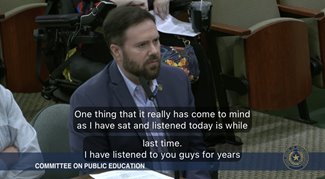
Public testimony on this item included testimony from dozens of parents, teachers, and community members, upset about budget shortfalls and closures of schools. One teacher said she will no longer be able to teach next year because her French program was being dropped to part-time status, resulting in a pay cut for her that would result in a salary that she cannot live on.
ATPE Governmental Relations Director Monty Exter testified on the Teacher Retention Allotment (TRA), specifically sharing results of a recent ATPE survey with the committee. He shared that while ATPE members are hugely appreciative of the pay raises received through the TRA, the survey results showed there are questions about allotment, how it is dispersed, and to whom it is dispersed. This is because of bill language that, as mentioned above, only gives raises to a “classroom teacher,” leaving out many key professionals in a school, including many who consider themselves teachers but may not be assigned the PEIMS code that qualifies them to get the TRA. Exter stressed that all educators need to be supported in order to support the student learning environment. ATPE also submitted written testimony.
Teacher recruitment and retention
Next, the committee shifted its focus to studying the issue of teacher recruitment and retention. Kelvey Oeser, TEA deputy commissioner for educator support, and Jacob Kirksey, a professor and researcher from Texas Tech University, presented evidence about how the 2025 session’s HB 2 and other recent legislation have impacted efforts to attract and retain teachers. Overall, the data presented tends to indicate that efforts such as the PREP allotment, which creates additional funding for the teacher pipeline, as well as the Teacher Incentive Allotment (TIA) program, are moving the needle in the correct direction to address recent crises in retention and preparation. There are, however, areas for improvement, particularly in access to the TIA and in attracting new teachers to the profession.
Rep. John Bryant (D–Dallas) questioned Kirksey regarding the shrinking of university educator preparation programs. Kirksey replied that this mainly happens due to lack of financial incentive for an educator candidate to choose traditional preparation routes or even a route such as a residency. “We’re asking folks to choose quality, which we know from every single study I’ve done in Texas but also from many others, that practicing being a teacher prior to doing it yourself is important,” Kirksey said. “And we see that not just in teaching, but everywhere. But in other professions, like if you were going to clerk, like at a law firm, you get paid that summer. Even folks get paid during their medical residency. When you don’t have that in teaching, we’re asking folks to choose spending that time not getting a salary when the alternative is they could do a fast track option … and I think that’s the biggest reason you’re seeing it. We’ve been asking teachers for a really long time to just kind of give their heart up and do the quality thing because it’s right when we know as human beings we are trying to be economically rational.”
Hinojosa distributed a chart to the committee showing that teacher pay, when adjusted for inflation, is down since 2014-2015. Speaking of TIA, “it really is inadequate,” Hinojosa said. “I get complaints about the Teacher Incentive Allotment all the time from educators … I think it’s important that we understand that base pay is down for teachers all over the state, and that we need to do something about base pay so that we can impact all teachers, not just those who are able to qualify for the Teacher Incentive Allotment.”
Regarding the TIA, Hinojosa also said: “It’s concerning to me that … since it [was] initiated in 2019, we’re not seeing a decrease in teachers leaving the classroom. It hasn’t stopped the bleeding.”
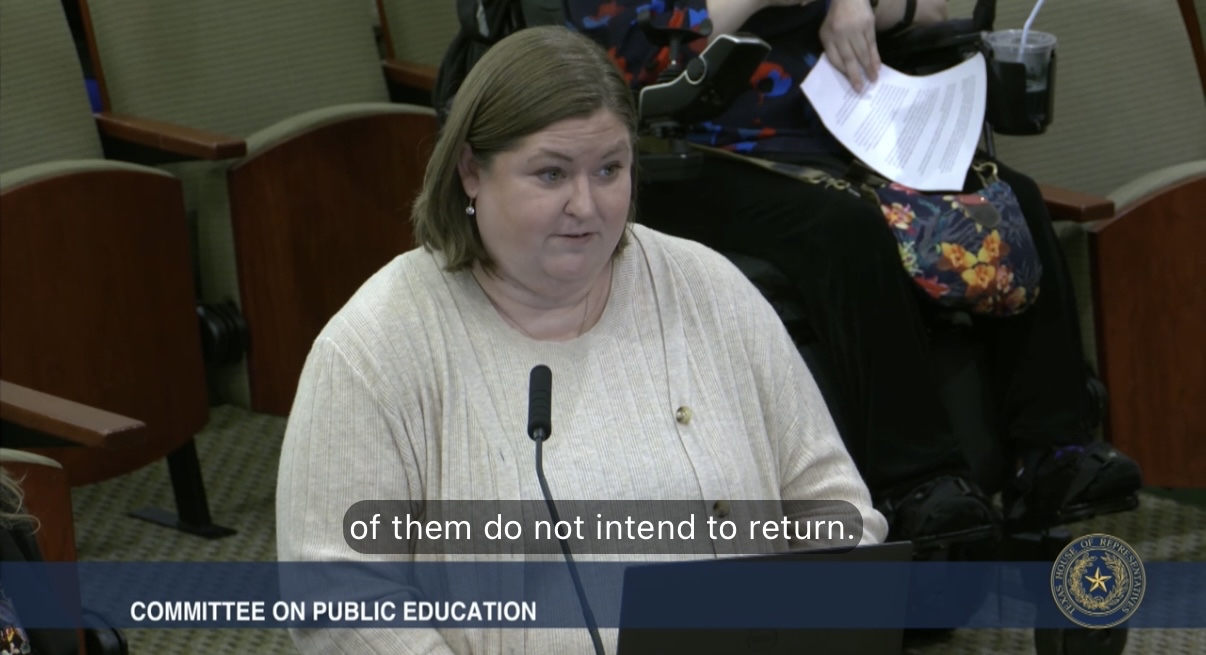
Rep. Trent Ashby (R–Lufkin) asked a panel of educators to name one thing the Legislature could do to incentivize people to go into the education profession. Debra Jenkins, an educator from Hearne ISD, responded that teachers would like to feel more heard and be given more opportunities to speak to legislators.
ATPE Lobbyist Tricia Cave testified on this charge, reminding the committee that there is still work to do in implementing the recommendations of the 2023 Teacher Vacancy Task Force, and that pay, while important, is not the only issue pushing teachers out of the classroom. Teachers also frequently cite workload, support, and work/life balance as reasons for leaving the classroom. Additionally, Cave shared results from ATPE’s recent educator survey, which showed that while our members who receive the TIA are thankful for the extra money, most of our members, even those who receive TIA, still see the system as flawed and inherently unfair. Cave asked the committee to study ways to improve the program so all teachers have the ability to qualify. ATPE also provided written testimony.
Special education
Lastly, the committee took up the charge of examining investment into special education. The committee heard from two panels of special education experts on how the change to service intensity funding is impacting special education. Steven Aleman from Disability Rights Texas urged the committee to exercise caution when studying the impact of the changes and allow time for districts to adjust and the model to be fully implemented.
Kami Finger, Lubbock ISD assistant superintendent for school support and special services, explained to the committee how the TEFA evaluation requirements under Senate Bill (SB) 2 have created an explosion in special education evaluations for school districts that leave them unable to meet the needs of their actual students. Under SB 2, any student who is applying for TEFA funds and wants to receive the additional money for special education services (around $20,000 more than the base TEFA amount) must go to their local school district to be evaluated for special education placement and services. This is despite the fact that private schools do not have to follow federal special education law and are not required to use a student’s Individualized Education Program (IEP). Districts receive $1,000 per evaluation under HB 2, but Finger pointed out the costs of these evaluations well exceed that amount. She asked the committee to consider creating a third-party system to handle TEFA evaluations.
ATPE Lobbyist Tricia Cave echoed these remarks in her testimony, thanking the committee for the new service intensity model but urging time for districts to adjust. She also asked for the third-party evaluation system advocated by Finger, as well as shared data from our recent educator survey that shows teachers feel unsupported and unprepared to support their students when dealing with inclusion in general education settings. Cave asked the committee to consider ways to provide educators with additional training and support resources such as paraprofessionals to help ensure student needs are met in inclusion settings. ATPE also provided written testimony.
The committee still has several interim charges to cover before making its report at the end of the year, so at least one and likely more interim hearings are expected. Teach the Vote will have updates as they are available.
CONVERSATION
RECOMMENDED FOR YOU

08/21/2026
Teach the Vote’s Week in Review: Aug. 21, 2026
Public education continues to dominate conversations on the campaign trail, with candidates turning their attention to library books and “administrative bloat.” Plus: House Pensions Committee holds interim hearing on TRS.

08/21/2026
On the Campaign Trail: Aug. 21, 2026
Abbott and Hinojosa both spent much of their airtime this week on public education issues, including a call from the governor to audit school districts.

08/21/2026
Analysis: A tale of two audits
An audit finds “administrative bloat” at TEA—but the governor turns his attention to his perception of the same issue in school districts.
Thank you for representing Texas Public School Educators and, in doing so, Texas public schools at this hearing last week, ATPE. Y''all brought up some immensely valuable insights and points in your testimony. Whether the legislators listen to the folks in the trenches will be an entirely different matter. Their track record doesn''t leave me hopeful. Again, thank you for what you do!