

Commissioner reviews STAAR results in June SBOE update

Date Posted: 6/25/2026 | Author: Heather Sheffield
Texas State Board of Education members received an update Wednesday, June 24, on the 2026 results from the State of Texas Assessment of Academic Readiness (STAAR). Texas Education Commissioner Mike Morath pointed to continued academic recovery in several subjects while highlighting both trends he sees as encouraging and persistent challenges across the state.
Although statewide performance remains below pre-pandemic levels in many areas according to STAAR results, Morath noted continuing upward trends in mathematics, social studies, and several high school end-of-course assessments, while commenting that the gains are “not good enough”. He also highlighted improvements among economically disadvantaged students and students receiving special education services, although significant achievement gaps remain.
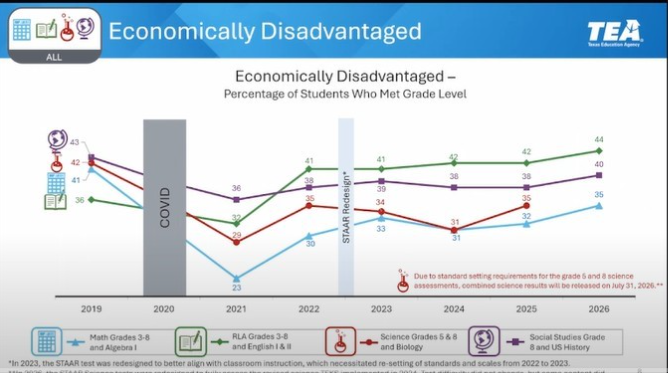
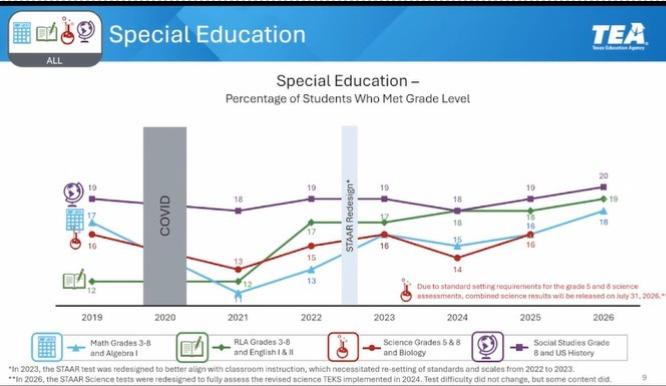
A major focus of the presentation was the state's effort to expand access to advanced mathematics coursework.
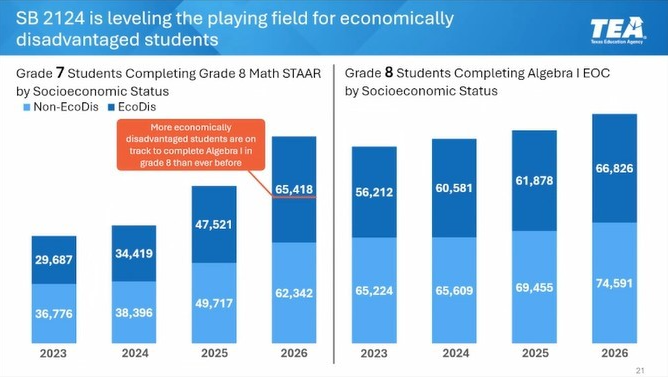
Morath credited Senate Bill 2124, bi-partisan legislation passed in 2023, with dramatically increasing participation in advanced math pathways by automatically placing qualifying students into accelerated coursework unless parents opt them out. According to the commissioner, the percentage of seventh-grade students taking the eighth-grade math assessment has nearly doubled over the last four years, while participation in Algebra I among middle school students has grown substantially.
Morath also pointed to significant increases among low-income students, arguing that automatic placement has expanded opportunities for students who previously may not have been as likely to be identified for advanced coursework. He described the policy as one of the clearest examples of a successful statewide education reform currently underway.
At the same time, Morath emphasized that many Texas students continue to struggle with foundational mathematics skills. While lauding the policy to allow students to increasingly move into accelerated coursework, statewide results show that the more rapid advancement may be depressing math scores, particularly in middle school. The commissioner argued that gaps in basic skills (including multiplication fluency, fractions, and ratios) continue to affect student performance as mathematical concepts become more complex in later grades. To address those challenges, the state is investing in math academies, intervention training, and instructional supports through House Bill 2, passed in 2025. However, Morath acknowledged that improving math outcomes statewide will require sustained effort over multiple years.
The discussion comes amid broader conversations about math performance across Texas, including attention on controversial reforms implemented in Houston ISD by a superintendent and board of managers handpicked by the Texas Education Agency (TEA). HISD’s changes dramatically reduced early access to advanced math classes at the district’s “NES” campuses, which runs counter to statute and, as multiple lawmakers speculate, is an attempt to manipulate the district’s STAAR scores at the expense of allowing students to attempt more challenging material on which they might not test as well.
Statewide, Reading Language Arts (RLA) performance was largely unchanged in elementary and middle school grades, with somewhat stronger gains appearing among older students. Morath noted that additional analysis will be needed to better understand the factors contributing to those improvements.
He briefly observed that the first year of Texas' statewide restrictions on student cell phone use coincided with stronger reading gains among secondary students than among younger students, though he cautioned that the state has not yet determined whether those trends are connected and that further analysis is necessary before drawing conclusions.
Morath also encouraged families to take advantage of the detailed information available through Texas' online STAAR reporting system, which allows parents to review individual test questions, student responses, writing samples, and personalized learning resources.
Though the commissioner did not discuss the fact that zero percent of third-graders earned full marks on the extended construction response (i.e. writing) portion of the RLA assessment, he did show how parents can view their child’s response.
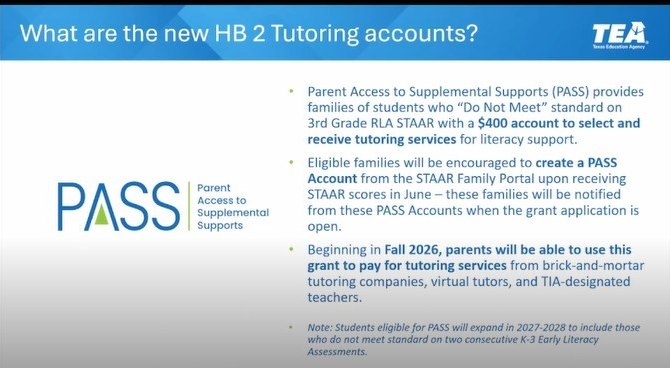
In addition, Morath highlighted the rollout of Parent Access to Supplemental Supports (PASS) accounts created through House Bill 2. Eligible students who do not meet grade-level expectations in third-grade reading may receive state-funded tutoring support designed to help address literacy challenges before they become more significant barriers to learning.
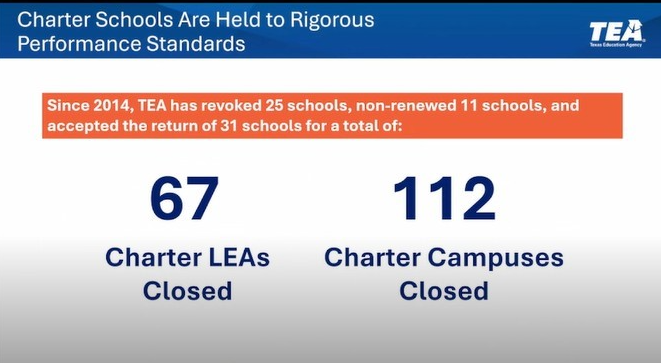
The Commissioner also made a very brief pitch for the rigor of the state’s charter school approval process, including the history of charter schools in Texas, noting how many have been approved and closed. He also highlighted a Houston area charter applicant encouraging the board to approve it, as opposed to exercising its veto authority. The charter vendor is focused on at-risk students who are over the typical age of high school students.
SBOE members, who began the meeting late due to a lack of quorum, were not given an opportunity to ask questions of the commissioner, as they normally do.
CONVERSATION
RECOMMENDED FOR YOU

08/21/2026
Teach the Vote’s Week in Review: Aug. 21, 2026
Public education continues to dominate conversations on the campaign trail, with candidates turning their attention to library books and “administrative bloat.” Plus: House Pensions Committee holds interim hearing on TRS.

08/21/2026
On the Campaign Trail: Aug. 21, 2026
Abbott and Hinojosa both spent much of their airtime this week on public education issues, including a call from the governor to audit school districts.

08/21/2026
Analysis: A tale of two audits
An audit finds “administrative bloat” at TEA—but the governor turns his attention to his perception of the same issue in school districts.